Most founders approach MVP development for startups like they’re building the final product on a budget. That approach wastes tons of precious time and distracts the team from focusing on business. MVPs should rather be treated as experiments that either prove that a product has real life potential or prove the contrary. It is in the team’s best interest to learn the results as fast as possible.
In this article, we’ll walk you through how to build an MVP and not get carried away in the process.
Why Build an MVP?
Most people will reply with “to validate the idea”. While this is technically correct, it is a pretty vague answer, and not being clear on what you want to achieve with an MVP leads to pretty vague results.
Here’s what a properly executed MVP does:
1. It validates VERY SPECIFIC assumptions
You’re validating whether your target user has the problem you think they have, whether they’ll change behavior to solve it, and whether your proposed solution addresses the core issue. Dropbox didn’t build file syncing to see if people wanted cloud storage – they already knew that. They validated whether a simple, automatic approach would beat manual methods enough for people to switch.
2. It identifies your riskiest assumptions before they’re expensive
Airbnb’s biggest risk wasn’t technology – it was whether strangers would sleep in each other’s homes. Their MVP (photographing apartments for a design conference) tested human behavior. They validated the core premise for under $1,000. Had they spent ages on developing a website, they would risk wasting all that time only to find out that even if people liked the idea, they wouldn’t use it in real life.
3. It forces ruthless prioritization
Instagram started as Burbn – a location-based check-in app with photo sharing, among other features. The MVP process revealed that users only cared about photos and filters. Everything else had to go. The feature you put all your money on can turn out to be worthless, while users can find value where you weren’t even looking.
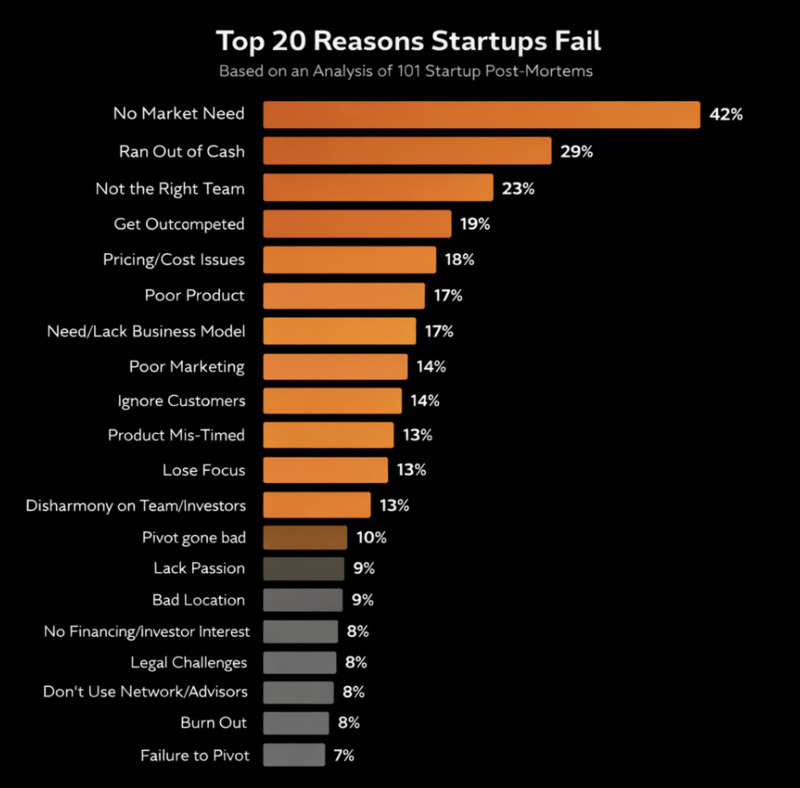
data source: cbinsights.com
4. It attracts the early stakeholders
A functioning MVP, even a raw one, demonstrates execution capability and market validation in ways pitch decks never will.
According to CB Insights research on startup failure, 42% of startups fail because there’s no market need for their product. An MVP doesn’t guarantee you’ll avoid this fate, but it dramatically increases your odds of discovering the mismatch before you’ve spent 18 months and burned through your seed round.
The Discovery Stage Determines Everything
Most MVPs fail because of decisions made before development starts. You can’t code your way out of a poorly defined problem. The teams that succeed in creating an mvp spend more time on the discovery stage than they do on initial development.
Sit down alone or with your team, and go through this checklist:
☐ Define your core assumption in one sentence
☐ Identify your target user very precisely
☐ Map the current solution even if it’s currently rough
☐ Calculate your validation threshold (how many users need to do what specific action for you to consider your assumption validated?)
☐ Determine a strict deadline by when the results should be enough to measure
☐ List the features you’re specifically NOT building
☐ Define your pivot triggers (what specific signals would tell you to change direction?)
How to Build Your MVP
Now we’re getting to the execution phase. Don’t mistake this for a traditional development project. Building an MVP for startup companies follows different rules than building enterprise software or scaling an existing product.
Choose Your Build Approach Based on What You’re Validating
Different assumptions require different types of MVPs. Match your build strategy to what you’re testing. Here are the most popular approaches:
Landing page + waitlist: Tests demand and messaging. Can be built with Webflow in a weekend.
Concierge MVP: Manually deliver your service to a small group. Tests whether you can solve the problem, regardless of automation.
Wizard of Oz MVP: Looks like a real product, but humans do the work behind the scenes. Tests user experience and willingness to engage. For instance, DoorDash founders personally delivered orders to validate demand before building driver networks and routing algorithms.
Single-feature MVP: One complete workflow, fully functional. Tests specific behavior change and product-market fit.
Piecemeal MVP: Combine existing tools to deliver your value proposition. Tests whether the value exists independent of your custom technology.
For most startups, the answer is some combination. A landing page to test messaging, followed by a concierge phase with early users, then a single-feature product for wider validation.
Think about what is the absolute minimum user flow that tests your core assumption. Then map this as a user journey.
For example, for a marketplace MVP, this might be: User A posts a need → User B sees the need → User B responds → Transaction occurs → Both parties confirm completion. Every feature exists to enable one step in this flow.
Make Architecture Decisions That Enable Learning
You don’t need to build a scalable product, you will change everything once you’ll be past validation. Your MVP architecture should focus on speed and flexibility.
- Pick a boring, reliable tech stack(React or Vue, Node.js or Python, PostgreSQL) because they’re fast to build with and easy to change.
- Use managed services for everything that isn’t your core value: Auth0 for authentication, Stripe for payments, SendGrid for email, AWS S3 for storage.
- Plan for throwaway code. Your MVP won’t survive to version 2.0, and that’s fine.
- But instrument everything from day one: add Mixpanel or Amplitude for user behavior, Sentry for errors, and logging for your validation metrics before you add your second feature. If you can’t measure it, you can’t learn from it.
Build in Two-Week Cycles With Hard Scoping
Time-box your development in two-week sprints with a ruthless definition of “done.” Each sprint should deliver something you can put in front of users (even if it’s only five test users).
Week 1-2: Core user authentication and primary action. Users can log in and perform the most basic version of your core feature.
Week 3-4: Minimum feedback loop. Users can complete one full cycle of value: create something, get a result, see the outcome.
Week 5-6: Basic polish and instrumentation. Fix obvious UX friction, add analytics, prepare for first external users.
Week 7-8: Beta launch to 10-50 users. Watch what breaks. Fix critical issues only. Start learning.
Notice that admin dashboards, edge case handling, password reset flows, comprehensive error messages, mobile responsiveness (if desktop works), desktop version (if mobile works) are absent from the list. Those come after you’ve validated that anyone cares.
Handle Data and Security Appropriately (But Don’t Overdo It)
Yes, we just told you to focus on validation, and forget about the rest. This will be an exception – nobody is exempt from basic security and data handling.
Do this:
- SSL certificates for anything collecting user data
- Environment variables for API keys and secrets
- Basic SQL injection and XSS protection
- Clear terms of service and privacy policy
- Regular backups of user data
- GDPR/CCPA compliance basics if relevant to your market
Don’t do this yet:
- Penetration testing and security audits
- SOC 2 compliance
- Advanced DDoS protection
- Multi-region redundancy
- Comprehensive disaster recovery
The threshold: protect user data and don’t be negligent or sloppy, but don’t spend weeks on security theater for a product with 50 beta users. You can level up as you scale.
How to Stay Focused on End Users
This part is usually less talked about, but:
An MVP succeeds or fails based on how well three groups stay aligned: the founding team, the development team (if external), and your early users. Lose alignment with any of them and your validation process collapses.
In order to zoom out from the countless details to see the bigger picture and keep your final goal in mind, set up a strict feedback process.
1. Set up a weekly sync—30 minutes, maximum—where you review three metrics: user acquisition, activation rate, and the specific behavior you’re trying to validate. What changed, why it changed, what you’re doing about it. This applies whether you’re working with an external development team or building in-house.
2. Document everything in real-time. Use Notion, Coda, or Linear to track decisions, user feedback, and iteration plans. When a user says something interesting, capture it immediately with context. When you decide to cut a feature, write down why. Your future self (and your team) will need this context when deciding what to build next.
3. Make user feedback a team sport. Your developers should talk to users. Your designer should watch user sessions. User insights should be direct and observed by everyone building the product.
4. Set clear decision rights and approval processes. Decide upfront: Who can add features to the roadmap? Who can say no? What requires team discussion versus individual judgment? For most early-stage MVPs, one person (usually the founder or product lead) should have final say on scope decisions.
5. Use asynchronous communication as default, synchronous as exception. If your team is constantly in meetings during MVP development, you’re moving too slowly. Document in writing, review asynchronously, meet only to decide and align.
6. Start small and expand your user base deliberately. Launch to 10 users, learn everything you can, fix critical issues, then expand to 50. Then 100. Then 500. Each phase teaches you something new. Trying to go from zero to thousands in your first week means you can’t process the feedback, can’t fix what’s broken, and can’t learn fast enough to iterate.
Your Path Forward
In theory, building an MVP is simple: validate your riskiest assumption as quickly as possible with the least amount of code.
Executing it well is hard: saying no to features, launching something intentionally incomplete, and changing direction based on evidence instead of intuition.
And if you’re looking for an mvp app development company – UniRidge is right here.
We’ve guided 50+ startups through the MVP process, from discovery stage through validated product-market fit.
Our approach: we spend the first two weeks challenging every assumption in your plan. If we can’t validate the problem and narrow the target user, we won’t write a line of code. That uncomfortable clarity is exactly what separates MVPs that generate signal from ones that burn runway.
If you’re ready to test your assumptions instead of just building your dream feature list, we should talk.
See our latest projects: